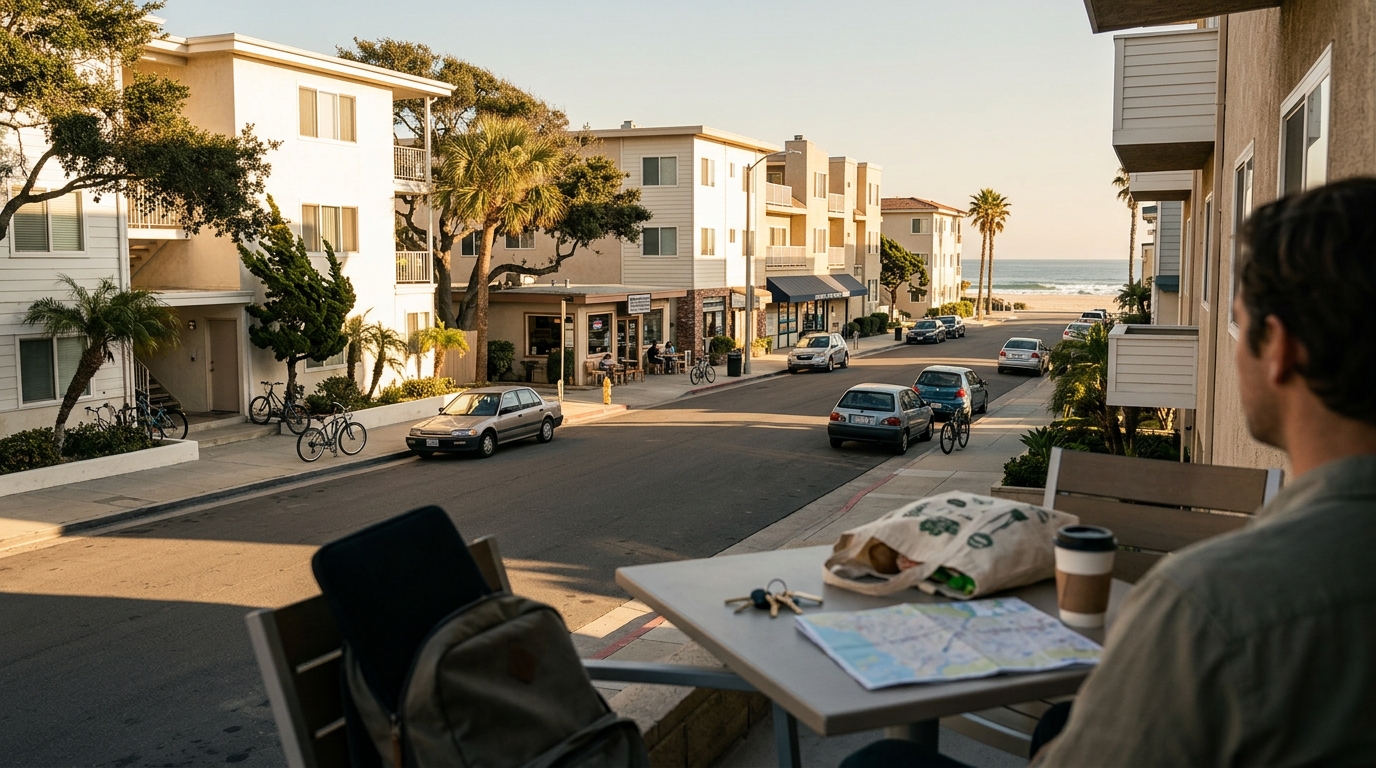
Learning how to live near the beach in the U.S. on a budget has become a dream for many remote workers, families, freelancers, retirees, and people who want a calmer lifestyle without giving up financial responsibility. For years, beach living in America was often associated with luxury condos, expensive vacation towns, crowded summer destinations, and oceanfront homes that seemed impossible for ordinary people to afford.
But coastal living is more complex than that.
Not every beach town is Malibu, Miami Beach, Nantucket, Key West, or an exclusive resort community.
Not every coastal lifestyle requires living directly in front of the ocean.
And not every person who wants to live near the beach needs a luxury apartment, a tourist district, or a high-end waterfront property.
For many people, the smarter strategy is not to live on the sand.
It is to live near the coast.
That difference matters.
Living directly on the beach can be extremely expensive. But living 10, 15, 20, or even 30 minutes from the shoreline can sometimes create a much better balance between lifestyle and budget. You may still enjoy the ocean, coastal air, weekend walks, beach sunsets, and a slower rhythm without paying the highest possible price for a beachfront address.
Remote work made this idea even more attractive.
If your income comes from online work, freelance clients, digital services, a remote job, or an online business, you may not need to live in the most expensive career hub. You can begin asking a different question:
Where can I live well, work reliably, and still have access to the beach without destroying my budget?
That question is where smart coastal living begins.
Beach Living Is Not Always Luxury Living
Many people imagine beach living as something only wealthy people can afford.
They picture oceanfront balconies, resort buildings, expensive restaurants, luxury marinas, and homes with direct beach access. And yes, those places exist. In many U.S. coastal markets, beachfront property can be extremely expensive.
But that is only one version of beach living.
There is another version.
A modest apartment in a neighborhood a few miles from the water.
A small house in a coastal city with ordinary grocery stores, schools, clinics, parks, and local workers.
A quiet town near the Gulf Coast.
A mid-sized city with beach access nearby.
A neighborhood that is not touristy but still close enough to the ocean for weekend walks.
A coastal region where locals live year-round, not only tourists during high season.
This version is less glamorous, but often much more realistic.
The key is to separate the beach fantasy from the daily-life reality.
You do not need to live in the most photographed area to enjoy the benefits of coastal living. In fact, the most famous beachfront areas are often the worst places for someone trying to manage costs.
They may have higher rent, more traffic, tourist pricing, expensive parking, seasonal crowds, stricter rental rules, and limited long-term housing.
A smarter approach is to search for livable coastal communities, not just beautiful vacation spots.
Why So Many Remote Workers Want to Live Near the Beach
Remote work changed how people think about location.
Before remote work became more common, many people lived where their office was located. They accepted traffic, high rent, expensive neighborhoods, and limited lifestyle choices because their job required it.
But when work can happen online, location becomes more flexible.
That flexibility leads many people to reconsider what they want from daily life.
Some want mountains.
Some want smaller cities.
Some want lower taxes.
Some want more space.
Some want to be closer to family.
And many want to be near the ocean.
The beach represents more than scenery. It represents a different rhythm.
Morning walks.
Natural light.
Outdoor exercise.
Less visual stress.
More contact with nature.
A feeling of space.
A reason to leave the house after work.
A calmer weekend routine.
For people who spend long hours in front of a screen, living near the beach can create a healthier separation between work and life.
But remote workers need to be practical.
A beautiful coastal city is not enough.
The city also needs reliable internet, workable housing, reasonable costs, access to healthcare, grocery stores, transportation, safety, and a lifestyle that functions beyond vacation season.
The goal is not only to live near the beach.
The goal is to live near the beach in a way that supports real life.
The Biggest Mistake: Choosing the Famous Beach First
The most common mistake people make is starting with famous beach names.
They search for the most popular beach towns and assume those are the best places to live.
But famous does not mean affordable.
Famous does not mean practical.
Famous does not mean peaceful.
Famous does not mean good for remote work.
A city that is perfect for a summer vacation may be stressful for year-round living.
Tourist areas often have seasonal pricing, crowded streets, limited parking, higher restaurant costs, noisy weekends, short-term rental pressure, and housing markets shaped by visitors rather than residents.
If you are trying to live near the beach on a budget, you need to look beyond the postcard.
Ask different questions.
Where do local workers live?
Which neighborhoods are 15 or 20 minutes from the beach?
Which nearby cities have lower rent?
Which areas have grocery stores, clinics, and reliable internet?
Which places are calm during the off-season?
Which cities are not completely dependent on tourism?
This is how you find better value.
Sometimes the smartest beach lifestyle is not in the famous beach town itself. It is in a nearby city that gives you access to the coast without the premium price.
Beachfront vs. Near the Beach
There is a huge financial difference between living beachfront and living near the beach.
Beachfront living usually means paying for the view.
That view can be beautiful, but it can also come with higher rent, higher property prices, higher insurance costs, more exposure to storms, more tourist traffic, more noise, and more maintenance.
Near-the-beach living can be much more flexible.
You may live a few miles inland but still reach the beach easily.
You may get a larger apartment for less money.
You may have better parking.
You may avoid the most tourist-heavy streets.
You may live closer to schools, supermarkets, hospitals, and local services.
You may reduce storm exposure depending on the area.
This is the core idea:
You do not need to pay for the beach view every morning if what you really want is beach access.
For budget-conscious remote workers, the best value is often not on the water. It is close enough to enjoy the water without paying the maximum price for it.
A 10-minute drive, a short bike ride, or a 20-minute walk can save a lot of money compared with living directly on the shore.
That trade-off can be worth it.
What to Check Before Choosing a U.S. Coastal City
Before choosing a beach city, you need to research more than rent.
Coastal living has specific costs and risks that people often forget.
Start with housing.
What is the average rent for a normal apartment, not a vacation rental?
Are long-term rentals available?
Do prices change by season?
Are there many short-term rentals competing with local residents?
Then check insurance and weather risk.
Coastal areas can be exposed to hurricanes, flooding, storms, humidity, salt air, and higher insurance costs. This does not mean you should avoid the coast, but it does mean you should understand the real cost.
Check internet.
For remote workers, this is non-negotiable. A beautiful beach town with weak internet is not a good remote work base.
Check healthcare.
Is there a hospital nearby? Are there clinics, urgent care centers, dentists, and specialists?
Check transportation.
Will you need a car? Is parking expensive? Is public transportation available? Are streets bike-friendly or walkable?
Check groceries and basic services.
A vacation area may have restaurants and souvenir shops, but not enough everyday infrastructure.
Check safety.
Some coastal cities have very different conditions from one neighborhood to another.
Check year-round lifestyle.
Is the city alive outside tourist season? Or does it become empty and inconvenient?
A good beach town for living should support your ordinary routine, not just your weekend dreams.
High Season Can Change the Entire Budget
Seasonality is one of the biggest traps in coastal living.
A city may feel affordable in one month and expensive in another.
During summer, holidays, festivals, spring break, winter escape seasons, or major events, prices can rise sharply. Short-term rentals may become expensive. Traffic may increase. Restaurants may raise pressure on local budgets. Parking may become harder. Beaches may become crowded.
If you are moving to a coastal city, do not judge affordability based on one month.
Look at the entire year.
Ask locals what happens during high season.
Check rental prices across different months.
Look at grocery, parking, restaurant, and utility costs.
Understand whether landlords prefer short-term tourists over long-term residents.
In some coastal markets, year-round housing can be harder to find because properties are used for vacation rentals.
This is why long-term planning matters.
A city that looks affordable during off-season may become financially stressful during peak months.
If your income is stable and you have a long-term lease, seasonality may be manageable.
If you rely on monthly stays or short-term rentals, seasonality can become a serious problem.
Internet and Remote Work: Do Not Assume It Works
For remote workers, the beach is only worth it if the internet works.
This sounds obvious, but many people ignore it.
They fall in love with a beautiful location and only later discover that the connection is unstable, the building has weak wiring, cell service is poor, or there are limited providers.
Before moving, research internet availability at the address level.
Not only the city.
The address.
Ask:
Is fiber available?
Which providers serve the building?
What speeds are offered?
Is the connection stable during storms?
Is cell coverage strong?
Is there a coworking space nearby?
Are there libraries or cafés with backup Wi-Fi?
Can I use a mobile hotspot if needed?
Can I work during peak tourist months when networks may be busier?
Remote work depends on reliability.
If your income comes from video calls, uploads, client meetings, online teaching, design work, coding, editing, consulting, customer support, or content creation, unstable internet can hurt your work.
A cheap beach town with poor connectivity may not be cheap if it damages your income.
U.S. Coastal Areas Worth Researching
This is not a ranking of the “best” beach towns in America. The U.S. coastal market changes constantly, and affordability depends heavily on neighborhood, timing, income, insurance, and housing availability.
Instead, think of the following areas as examples worth researching if you want coastal access without automatically choosing the most expensive beach markets.
1. Gulfport, Mississippi
Gulfport can be worth researching for people who want Gulf Coast access without the price tag of more famous Florida destinations.
It offers beaches, coastal culture, and access to nearby areas along the Mississippi Gulf Coast. The region can appeal to people who want a slower pace, lower-key coastal living, and a more practical alternative to expensive resort towns.
For remote workers, the key is to research neighborhoods carefully and verify internet options. Like many coastal areas, the experience can vary depending on location.
Gulfport may not offer the polished lifestyle image of a luxury beach market, but that is part of why it can be interesting for budget-conscious people.
It is a place to evaluate for affordability, access to the water, local services, and day-to-day practicality.
2. Ocean Springs, Mississippi
Ocean Springs is often associated with arts, local culture, and a charming coastal atmosphere.
It can appeal to people who want a coastal lifestyle with more personality than a generic beach town. The area has local shops, restaurants, galleries, and access to the Gulf Coast environment.
For someone working remotely, Ocean Springs may offer a more relaxed lifestyle while still keeping access to nearby regional services.
However, as with any attractive coastal town, you need to compare rent carefully. Charming places can become more expensive as they gain attention.
Also research storm risk, insurance, internet, and whether the neighborhood works year-round, not only during weekend visits.
Ocean Springs is a good example of why “affordable beach living” is not only about price. It is also about character, routine, and whether the community fits your life.
3. Pensacola, Florida
Pensacola can be interesting for people who want Florida beach access without immediately choosing Miami, Tampa, Naples, or the most expensive parts of the state.
It has a Gulf Coast identity, beaches nearby, a historic downtown, military presence, and a more relaxed feel than some larger Florida metros.
For remote workers, Pensacola may offer a balance between coastal lifestyle and city services. It has restaurants, healthcare access, shopping, and airport access, depending on where you live.
But Florida coastal living comes with important considerations.
Insurance, storms, humidity, seasonal demand, and rising housing costs all matter.
Pensacola is not automatically cheap, but it may offer better value than more famous Florida beach destinations if you choose neighborhoods carefully and avoid tourist-heavy areas.
The smartest strategy is to compare inland neighborhoods and nearby communities, not only beach-adjacent rentals.
4. Jacksonville, Florida
Jacksonville is a large city, but it can be worth considering because it offers coastal access, urban infrastructure, and more neighborhood variety than smaller beach towns.
For remote workers, that can be useful.
You may find areas closer to the beach, areas closer to downtown, suburban neighborhoods, and more affordable zones depending on your needs.
Jacksonville also offers more services than many small beach towns: hospitals, airport access, business activity, restaurants, and a wider housing market.
The trade-off is size. Jacksonville is spread out, and car dependency can be significant. The lifestyle may vary dramatically depending on where you live.
If you want beach access but do not want to give up the infrastructure of a larger city, Jacksonville may be worth researching.
But you need to study neighborhoods carefully. The experience can change a lot from one area to another.
5. Wilmington, North Carolina
Wilmington offers access to beaches, a historic riverfront, and a coastal North Carolina lifestyle that attracts many people looking for a softer pace.
It can be appealing for remote workers who want a mix of charm, beach access, restaurants, and a city that feels smaller than major metros but still functional.
Nearby beach areas can be more expensive, so the best value may be found outside the most desirable waterfront zones.
Wilmington is also a place where you need to research storms, flooding, insurance, and seasonal pricing. Like many coastal cities, the beauty comes with practical considerations.
For people who want East Coast beach access without moving to a huge city, Wilmington can be an attractive option to study.
It may work especially well for people who value history, coastal scenery, and a more relaxed daily rhythm.
6. Myrtle Beach and Nearby Inland Areas, South Carolina
Myrtle Beach is famous as a tourist destination, which means it requires careful research.
The main beach areas can be busy, seasonal, and shaped by tourism. But the broader region may still be interesting for people who want coastal access and a lower-cost alternative to more expensive beach markets.
For budget-conscious living, the smartest move may be to look beyond the most tourist-heavy streets.
Nearby inland neighborhoods, surrounding towns, or less central areas may offer better value while still keeping the beach accessible.
Myrtle Beach also has many restaurants, entertainment options, and services because of its tourism economy. That can be convenient, but it can also bring traffic and seasonal crowds.
This is the kind of place where you should ask locals what living there feels like year-round.
A vacation impression is not enough.
7. Virginia Beach and Nearby Areas, Virginia
Virginia Beach can offer beach access with a larger metropolitan environment nearby.
It may appeal to people who want the ocean but also want access to more services, employment diversity, military communities, healthcare, and regional infrastructure.
The area can be more expensive than some smaller coastal cities, especially near the most desirable zones. But nearby neighborhoods and surrounding communities may offer different price points.
For remote workers, the advantage is that Virginia Beach is not isolated. It is part of a broader region with services, airports, and city infrastructure.
The key is to define what you actually want.
Do you want to be near the ocean every day?
Do you want a quieter residential area?
Do you need schools?
Do you want nightlife?
Do you need airport access?
Your ideal neighborhood may not be the one closest to the sand.
8. Corpus Christi, Texas
Corpus Christi can be worth researching for people who want Gulf Coast living in Texas.
It offers coastal access, a lower-key lifestyle than some larger Texas metros, and a different cost profile than many famous beach destinations.
However, as with any coastal city, you need to study weather, insurance, storm risk, neighborhood safety, and job options carefully.
For remote workers, the main questions are internet, housing, healthcare, and daily convenience.
Corpus Christi may appeal to people who want warm weather, water access, and a more practical coastal lifestyle without moving to a luxury beach market.
It is not for everyone, but it belongs on the research list for budget-conscious coastal living in the U.S.
9. Mobile and Dauphin Island Access, Alabama
Mobile itself is not a classic beach town, but it can offer access to the Gulf Coast region while potentially providing more affordable housing than many beachfront areas.
This is an important strategy: sometimes the best way to live near the beach on a budget is to choose a coastal-adjacent city instead of a direct beach town.
Mobile can provide more city infrastructure, services, and housing variety while keeping beach trips within reach.
Nearby coastal areas and islands may offer the beach experience without requiring you to live in the most expensive spot.
This may not satisfy someone who wants to walk to the sand every morning. But for someone who wants coastal access, lower costs, and a more practical base, it may be worth considering.
10. Coastal Georgia Beyond the Most Famous Areas
Georgia’s coast can be attractive, but famous places can become expensive quickly.
Instead of focusing only on the most popular destinations, budget-conscious movers should research smaller towns, inland neighborhoods near the coast, and areas with access to services.
The Georgia coast offers history, marsh landscapes, beaches, and a distinctive atmosphere. But affordability depends heavily on location.
As always, the key is not to chase the most famous name.
The key is to compare real housing, year-round costs, healthcare, internet, transportation, and risk factors.
For remote workers who want a quieter coastal lifestyle, parts of coastal Georgia may be worth studying carefully.
Do You Need to Live in a Beach Town at All?
Here is the question many people forget:
Do you really need to live in a beach town, or do you just want regular access to the beach?
This difference can save money.
You may not need to live in the actual coastal town. You may be happy living in a nearby city 20 to 40 minutes away.
This can open many more options.
A nearby inland city may offer better rent, better grocery options, better schools, better hospitals, better internet, and less tourist pressure.
You still get beach weekends, sunset drives, morning visits, and coastal access.
But you avoid paying the highest premium.
For many people, this is the smartest version of beach living.
It is not about proving you live on the beach.
It is about designing a lifestyle that gives you access to what you value without damaging your finances.
The Budget Questions You Must Answer First
Before moving near the beach, answer these questions honestly:
How much can I afford for rent or mortgage?
How stable is my income?
Do I need a dedicated home office?
How much will utilities cost?
Will I need flood insurance or higher insurance coverage?
Do I need a car?
How far am I willing to live from the beach?
Is the city affordable year-round or only in off-season?
Will tourism affect my lifestyle?
Is the internet reliable enough for work?
Can I access healthcare easily?
Do I have an emergency fund?
Can I handle storm risk or evacuation planning?
Would I still like the city if I could not go to the beach for a week?
That last question matters.
A good coastal city must work as a city, not only as a beach.
When Beach Living Is Worth It
Living near the beach may be worth it if the lifestyle genuinely improves your daily life.
If you walk more, feel calmer, spend more time outdoors, enjoy simple routines, work better, and feel healthier, coastal living can be valuable.
It may also be worth it if you can keep housing costs reasonable and avoid lifestyle inflation.
For remote workers, the beach can become a natural reset after work. Instead of ending the day exhausted in traffic, you may take a walk near the water, exercise outside, or enjoy a quieter evening.
That kind of lifestyle can improve mental health and overall well-being.
But it is only worth it if the numbers work.
If the beach lifestyle forces you into debt, financial stress, or unstable housing, the dream can become pressure.
A good life near the beach should feel lighter, not heavier.
When Beach Living May Not Be the Right Choice
Beach living may not be right if your budget is already tight, your income is unstable, or you need access to specialized jobs that are not available locally.
It may also be difficult if you dislike humidity, storms, tourism, seasonal crowds, or car-dependent areas.
Some people romanticize beach life but later miss urban culture, professional communities, public transportation, or family support.
Others discover that they prefer visiting the beach rather than living near it.
That is okay.
The goal is not to force a dream.
The goal is to choose honestly.
Before moving, try staying in the area for a few weeks outside vacation mode.
Work from there.
Cook there.
Run errands.
Drive around.
Check internet.
Visit grocery stores.
Explore neighborhoods.
Talk to locals.
Experience normal life.
If the city still feels good during ordinary days, it may be a strong option.
Final Thoughts
Living near the beach in the U.S. without destroying your budget is possible, but it requires a smarter strategy than simply choosing a famous beach town.
The most affordable coastal lifestyle is often not beachfront luxury.
It is practical access.
A modest neighborhood near the coast.
A city a few miles inland.
A less famous beach region.
A mid-sized city with good services and ocean access.
A place where rent, internet, healthcare, transportation, insurance, and daily life work together.
Remote work has made this dream more realistic for many people, but it has not removed the need for planning.
The beach should not be an excuse to ignore the numbers.
The smartest choice is a place that supports both your lifestyle and your budget.
Because the real dream is not just waking up near the ocean.
It is building a life where you can enjoy the ocean without feeling financially trapped.
And that is the difference between a beach fantasy and a beach life that actually works.














Post Comment