Many parents are not only looking for a better job anymore.
They are looking for a better childhood for their children.
That is a very different kind of search.
For decades, living in a large capital city was seen as the obvious path to opportunity. Big cities promised better salaries, better universities, more companies, more entertainment, more hospitals, more connections, and more possibilities.
But many families are now asking a more uncomfortable question:
What if the city with the most opportunities is not always the best city for daily life?
Traffic, expensive housing, safety concerns, pollution, long commutes, crowded schools, pressure, noise, and lack of green space are making many parents rethink what success actually means.
A high salary loses part of its meaning when parents barely have time to see their children.
A famous city loses part of its charm when daily life feels like a race.
A career opportunity can feel less exciting when the cost is stress, exhaustion, and a childhood spent mostly indoors.
This is why family-friendly cities are becoming more interesting.
Parents are not only comparing salaries anymore. They are comparing parks, schools, healthcare, transportation, safety, housing, walkability, air quality, community, and the amount of time they can actually spend together as a family.
The best city for raising children is not always the most famous city.
It is not always the richest city.
It is not always the largest city.
Sometimes, it is the city where a child can walk to school, ride a bike, play outside, visit a park, access good healthcare, grow up around culture, and see their parents less overwhelmed.
This article is not a perfect ranking. No city is perfect for every family. Cost, visas, language, taxes, schools, housing, culture, climate, and job opportunities can change everything.
But these 10 family-friendly cities around the world show an important trend: more families are searching for calmer, safer, and more balanced places to live.
What Makes a City Family-Friendly?
A family-friendly city is not only a beautiful city.
A beautiful city can still be stressful, expensive, unsafe, or impractical for raising children.
A truly family-friendly city usually combines several factors.
Safety matters because parents need to feel comfortable with daily routines, school commutes, parks, and public spaces.
Education matters because children need access to good schools, learning opportunities, libraries, cultural activities, and extracurricular options.
Healthcare matters because families need reliable doctors, hospitals, emergency care, and preventive services.
Green spaces matter because children need room to move, play, breathe, explore, and spend time outdoors.
Transportation matters because a city becomes easier when families can move without spending hours in traffic every day.
Housing matters because even a great city can become impossible if rent or property prices consume the entire budget.
Community matters because families need connection, support, and a sense of belonging.
Work-life balance matters because children do not only need a good city. They need parents with time, energy, and emotional presence.
That is why choosing where to raise children is not just a financial decision.
It is a lifestyle decision.
A city that works well for a single professional may not work well for a family. A place that is exciting for nightlife may be exhausting for parents. A city that looks perfect on vacation may feel completely different during school weeks, grocery shopping, doctor appointments, and everyday routines.
The goal is not to find a perfect place.
The goal is to find a place where the daily rhythm of family life feels more sustainable.
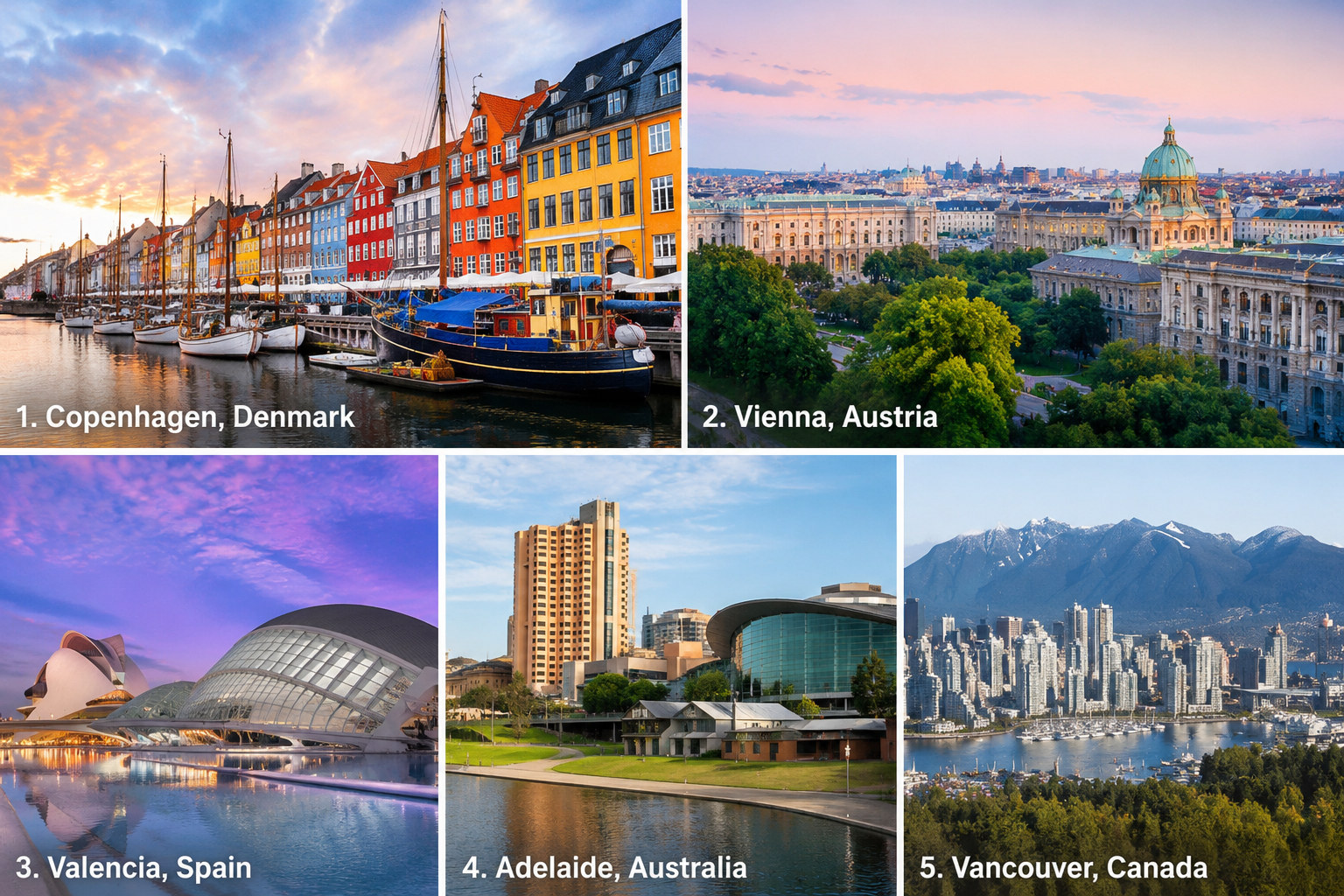
1. Copenhagen, Denmark
Copenhagen often appears in conversations about quality of life, urban design, cycling culture, and family-friendly living.
For many parents, the appeal of Copenhagen is not only beauty. It is the way the city seems designed around daily life.
Cycling is part of the culture. Public spaces are valued. Parks, waterfront areas, playgrounds, libraries, and cultural activities are integrated into the city. The urban environment encourages movement, outdoor time, and a less car-dependent routine.
For families, this can be powerful.
A city where children grow up seeing bicycles, parks, clean public spaces, and independent movement can create a different type of childhood.
Copenhagen also has a reputation for strong public services, education, safety, and social infrastructure. Parents who value structure, predictability, and a calmer rhythm often find the city attractive.
But Copenhagen is not cheap.
Housing can be expensive, taxes are high, and the cost of living may surprise newcomers. For families moving from lower-cost countries, the financial adjustment can be significant.
The city may be ideal for families who value safety, sustainability, education, public services, and urban planning more than low living costs.
Copenhagen is not about cheap living.
It is about quality of life.
For parents who want a city where children can grow with more independence, outdoor culture, and daily structure, Copenhagen deserves attention.
2. Vienna, Austria
Vienna is one of the most admired cities in the world for quality of life.
It combines history, culture, public transportation, healthcare, education, parks, and urban organization in a way that can be very attractive for families.
One of Vienna’s biggest strengths is balance.
It feels like a major European capital, but it is often described as more manageable than many larger global cities. Families can enjoy museums, music, parks, cafés, schools, public transport, and cultural life without the same level of chaos found in some bigger capitals.
For children, Vienna offers exposure to culture from an early age.
Museums, music, architecture, public spaces, and multilingual environments can make the city feel educational beyond the classroom.
Public transportation is another important advantage.
When families can move around without depending heavily on cars, daily life can become easier and less stressful.
Vienna also has many green areas and a strong tradition of public life. Parks, playgrounds, and walkable neighborhoods can help families build routines that are less trapped indoors.
The challenge is that Vienna is still a European capital. Housing, bureaucracy, language, and immigration rules need careful research.
It may not be the easiest city for every newcomer, especially without German or a clear legal path.
But for families who can access it, Vienna offers one of the most complete combinations of culture, safety, infrastructure, and calm urban living.
It is a city where family life can feel organized without feeling boring.
3. Valencia, Spain
Valencia is one of the most interesting cities in Europe for families looking for a mix of city life, beach access, climate, culture, and relatively better value compared with Madrid or Barcelona.
It is not a small town, and it is not hidden anymore. More expats, remote workers, and families have discovered Valencia in recent years.
But it still offers a strong family-friendly combination.
There are beaches, parks, bike lanes, public transportation, schools, food markets, cultural events, and a Mediterranean rhythm that can feel less intense than larger European capitals.
For families, climate matters more than people think.
A city with pleasant weather encourages outdoor life. Children can spend more time in parks, plazas, sports activities, and beach areas. Parents may feel less trapped in indoor routines.
Valencia also has the advantage of being a real city, not only a tourist destination.
That means access to healthcare, universities, transportation, services, and professional opportunities is stronger than in a small beach town.
The challenge is popularity.
As more people move to Valencia, housing costs can rise. Some neighborhoods may become expensive, and finding the right school or rental may require planning.
Still, Valencia can be attractive for families who want European lifestyle, beach access, urban services, and a more relaxed daily rhythm than some larger cities.
It is especially interesting for remote workers and digital professionals who want a city that supports both work and family life.
4. Adelaide, Australia
Adelaide is often described as calmer and more affordable than some of Australia’s larger cities, while still offering strong quality of life.
For families, that can be a powerful combination.
Sydney and Melbourne may be more famous internationally, but they can also feel expensive, competitive, and fast-paced. Adelaide offers a different rhythm.
It has beaches, parks, schools, universities, healthcare, cultural festivals, and a more relaxed lifestyle. The city is large enough to offer services and opportunities, but not so large that everything feels overwhelming.
This can matter a lot for parents.
A city with shorter commutes, accessible outdoor spaces, and a less intense pace can improve family life significantly.
Adelaide also offers access to nature, wine regions, coastlines, and community-oriented neighborhoods. For families who enjoy outdoor activities, this can create a better weekend lifestyle.
The challenge is distance.
Australia is far from many parts of the world. For immigrant families, visiting relatives can be expensive and time-consuming. Visa rules, work rights, healthcare access, and school options need careful research.
Adelaide may not be the best option for families who need to stay close to Europe, Latin America, or North America.
But for those who can build a life in Australia, it can offer a calmer alternative to bigger Australian cities.
It is the kind of place that may not shout for attention, but quietly makes daily life easier.
5. Vancouver, Canada
Vancouver is famous for its natural beauty.
Mountains, water, parks, forests, and urban life come together in a way that few cities can match. For families who value nature, outdoor activities, and multicultural living, Vancouver can feel extremely attractive.
Children can grow up with access to parks, beaches, trails, sports, libraries, community centers, and diverse cultural experiences.
The city is also known for its international atmosphere. Families from many backgrounds live there, which can make adaptation easier for some newcomers.
For parents, Vancouver offers a mix of urban services and nature that is hard to find.
It is possible to live in a modern city while still feeling close to the outdoors.
But Vancouver has one major challenge: cost.
Housing can be very expensive. The cost of living is high, and families need to plan carefully before considering a move.
For some families, Vancouver may be ideal on paper but difficult financially.
That does not mean it should be ignored. It means the dream needs numbers.
A family considering Vancouver should study neighborhoods, school areas, transportation, childcare costs, healthcare access, income expectations, and long-term housing possibilities.
Vancouver is not necessarily the easiest city.
But for families with the right income and legal path, it can offer a high-quality environment for raising children close to nature.
6. Auckland, New Zealand
Auckland can be attractive for families who value nature, safety, outdoor life, and a slower pace compared with some larger global cities.
New Zealand has a strong image around quality of life, landscapes, education, and family-friendly culture. Auckland, as the country’s largest city, offers more jobs, services, schools, and international connections than many smaller places.
For families, Auckland’s appeal is often connected to balance.
There are beaches, parks, volcanic landscapes, coastal areas, family neighborhoods, and access to outdoor activities. Children can grow up with more contact with nature while still living in a major city.
Auckland can also feel less overwhelming than megacities.
It offers urban life without the same scale of density found in places like London, Tokyo, or New York.
However, Auckland is not cheap.
Housing can be expensive, and distance from other countries can be a challenge for immigrant families. Flights to visit relatives may cost a lot, and the job market can be competitive depending on the profession.
Still, Auckland may be a strong choice for families who want English-speaking education, nature, outdoor lifestyle, and a long-term environment that feels less aggressive than many large urban centers.
For parents who dream of a childhood with beaches, green areas, and more breathing room, Auckland is worth researching carefully.
7. Porto, Portugal
Porto is a strong option for families who want European life but prefer something smaller and more human than a large capital.
Lisbon often receives more attention, but Porto has its own charm.
The city offers history, culture, walkable areas, access to the coast, public transportation, universities, hospitals, cafés, parks, and a slower rhythm than many bigger European cities.
For families, Porto can feel more intimate.
It is large enough to provide services and opportunities, but not so large that daily life feels impossible.
Portugal also attracts many international families because of safety, climate, culture, and relative accessibility compared with some other Western European countries.
Porto can be especially interesting for families who want a European base without choosing the most expensive or most crowded destination.
But it still requires planning.
Housing prices have increased in popular areas. Schools, visas, taxes, healthcare access, and language should be studied carefully. Families who do not speak Portuguese may need time to adapt.
The weather can also be wetter and cooler than some people expect.
Still, Porto offers a strong combination of culture, beauty, family routine, and access to both urban life and coastal areas.
For families who want Europe with character, Porto can be a thoughtful choice.
8. Ljubljana, Slovenia
Ljubljana is not as famous as Paris, London, or Barcelona.
That may be exactly why it is interesting.
The capital of Slovenia is smaller, greener, calmer, and more manageable than many European capitals. For families, that can be a major advantage.
A smaller city can mean shorter distances, less stress, easier routines, and more contact with parks, community spaces, and nature.
Ljubljana is often admired for its walkable center, green identity, cafés, cultural life, and access to outdoor activities. Slovenia also offers mountains, lakes, forests, and nature within relatively short distances.
For families who want a European lifestyle without the intensity of a huge capital, Ljubljana may be worth considering.
Children can grow up in a city that feels urban but not overwhelming.
Parents may find a better rhythm if they value calm, nature, safety, and daily simplicity.
The challenge is that it is a smaller market.
Job opportunities may be more limited depending on the industry. International schools, language adaptation, local bureaucracy, and housing availability need research.
Ljubljana may be better for remote workers, families with flexible income, or people who already have a clear professional path.
It is not the obvious choice.
But sometimes the best family cities are not the obvious ones.
9. Utrecht, Netherlands
Utrecht can be a smart alternative for families who like the Netherlands but do not want the intensity of Amsterdam.
It offers canals, cycling culture, education, public transportation, parks, historic charm, and a strong urban structure.
For families, Utrecht has a very practical advantage: it feels connected but not as overwhelming as the country’s most famous city.
The Netherlands is known for cycling infrastructure, and this can strongly affect family life. In a bike-friendly environment, children and parents may move around with more independence and less dependence on cars.
Utrecht also has a lively but manageable atmosphere.
It offers universities, culture, cafés, public spaces, and access to other Dutch cities by train.
For parents, this can mean opportunity without constant chaos.
However, the Netherlands can be expensive, and housing availability can be difficult. Families need to research rent, schools, taxes, healthcare insurance, and local registration rules.
The weather may also be a challenge for people coming from warmer countries.
But for families who value structure, cycling, education, and a well-connected European lifestyle, Utrecht can be a very attractive city.
It may not have Amsterdam’s global fame, but that can make it feel more livable for families.
10. Osaka, Japan
Osaka offers a different kind of family-friendly appeal.
Japan is known for safety, public transportation, cleanliness, efficiency, and strong urban organization. For families, these factors can matter deeply.
Osaka is a major city, but compared with Tokyo, it can feel more approachable in some ways. It offers excellent transportation, food culture, schools, parks, shopping areas, healthcare access, and cultural experiences.
For children, growing up in a city like Osaka can mean exposure to safety, independence, public transit, and respect for shared spaces.
Parents may appreciate the convenience of transportation, the availability of services, and the general sense of order.
Osaka also has a more relaxed reputation than Tokyo, with a strong local identity and lively culture.
However, Japan requires serious preparation.
Language can be a major barrier. Work visas, school adaptation, housing rules, and cultural differences should not be underestimated. International families need to research carefully before moving.
Osaka may not be the easiest city for every foreign family, but it can be a strong option for those who value safety, infrastructure, and urban efficiency.
It is a reminder that family-friendly does not always mean quiet or small.
Sometimes it means a city that functions extremely well.
How to Choose the Right Family-Friendly City
A list can inspire you, but it cannot decide for you.
The best city depends on your family.
Before choosing a place to raise children, ask practical questions.
Can we legally live there?
Can we afford housing?
Are schools accessible?
How does healthcare work?
Is the city safe for children?
Can children play outside?
How long will daily commutes be?
Will we need a car?
What language will our children study in?
Will we have a support network?
Can we work there or earn remotely?
What happens if income changes?
How far will we be from relatives?
What kind of childhood do we want our children to have?
These questions matter more than a ranking.
A city that looks perfect online may not fit your budget.
A city with great schools may not fit your visa situation.
A city with beautiful parks may not offer the job opportunities you need.
A city with lower costs may lack the healthcare or education you want.
Family decisions need more than inspiration.
They need planning.
The Best City Is Not Always the Most Famous One
Many parents assume that the best place for their children must be a famous global city.
But fame can be expensive.
Famous cities often attract tourists, investors, remote workers, and international demand. That can raise housing costs and make daily life harder.
Sometimes a second-tier city, smaller capital, or less obvious destination offers a better balance.
Families often need something different from tourists.
Tourists want attractions.
Families need routine.
Tourists want excitement.
Families need safety.
Tourists want famous places.
Families need schools, doctors, parks, supermarkets, transportation, and calm mornings.
That is why the most famous city is not always the best family city.
The better question is:
Where can our family live well every day?
Not just for a weekend.
Not just for photos.
Every day.
Final Thoughts
More families are rethinking where they want to live.
They are not only chasing bigger salaries, famous addresses, or crowded capitals.
They are asking deeper questions.
Where can my children grow with more freedom?
Where can we have more time together?
Where can daily life feel safer and less exhausting?
Where can education, healthcare, nature, and work-life balance exist in the same routine?
There is no perfect city.
Copenhagen can be expensive.
Vienna requires adaptation.
Valencia is becoming more popular.
Adelaide is far from much of the world.
Vancouver can be financially difficult.
Auckland is distant.
Porto has rising housing costs.
Ljubljana may have a smaller job market.
Utrecht can be competitive for housing.
Osaka requires cultural and language preparation.
Every city has trade-offs.
But the search itself reveals something important.
Parents are no longer thinking only about where they can work.
They are thinking about where their children can live well.
And that may be one of the biggest lifestyle shifts of our time.
A good family-friendly city is not only a place with nice buildings.
It is a place where childhood has room to breathe.
A place where parents are not constantly fighting the city.
A place where safety, education, parks, healthcare, transportation, and community make daily life more human.
The best city for your family may not be the most famous one.
It may be the one that gives your children more time, more nature, more safety, and more balance.
And sometimes, that is worth more than living in the center of everything.













Post Comment